Moray Eels in Thailand: Species, Where to See Them & Safety
Which moray eels live in Thailand, where divers spot them in the Andaman Sea, and how to stay safe around them. Species guide plus dive-site tips.
On this page
Last updated November 2026. Moray eel Thailand sightings are most common on Andaman Sea dive sites, where at least eight species turn up in reef crevices. Morays are generally non-aggressive when you give them space. This guide covers which species to expect, where to look, and how to behave around them.
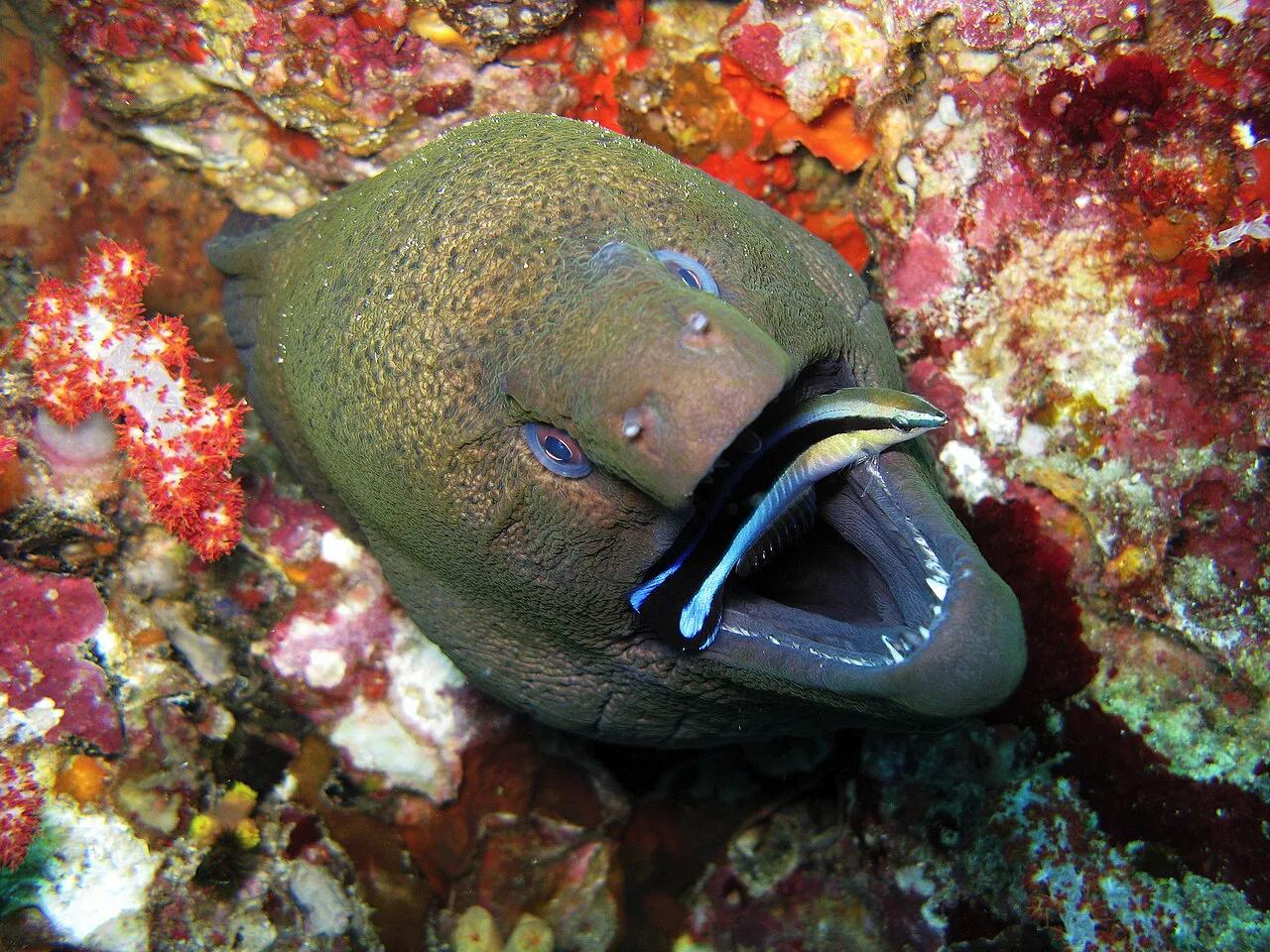
Featured image: Silke Baron, CC BY 2.0, via Wikimedia Commons.
Moray Eel Species You Can See in Thailand
Morays belong to the family Muraenidae, and Thai reefs hold species from several genera. Despite the snake-like body, they are fish. Our Thailand marine life guide covers the wider reef cast. Dive operators around Koh Lanta list eight species on their local marine-life pages. Sizes below are maximums unless a typical range is given. Sizes in the table come from operator and park datasheets, so treat them as approximate.
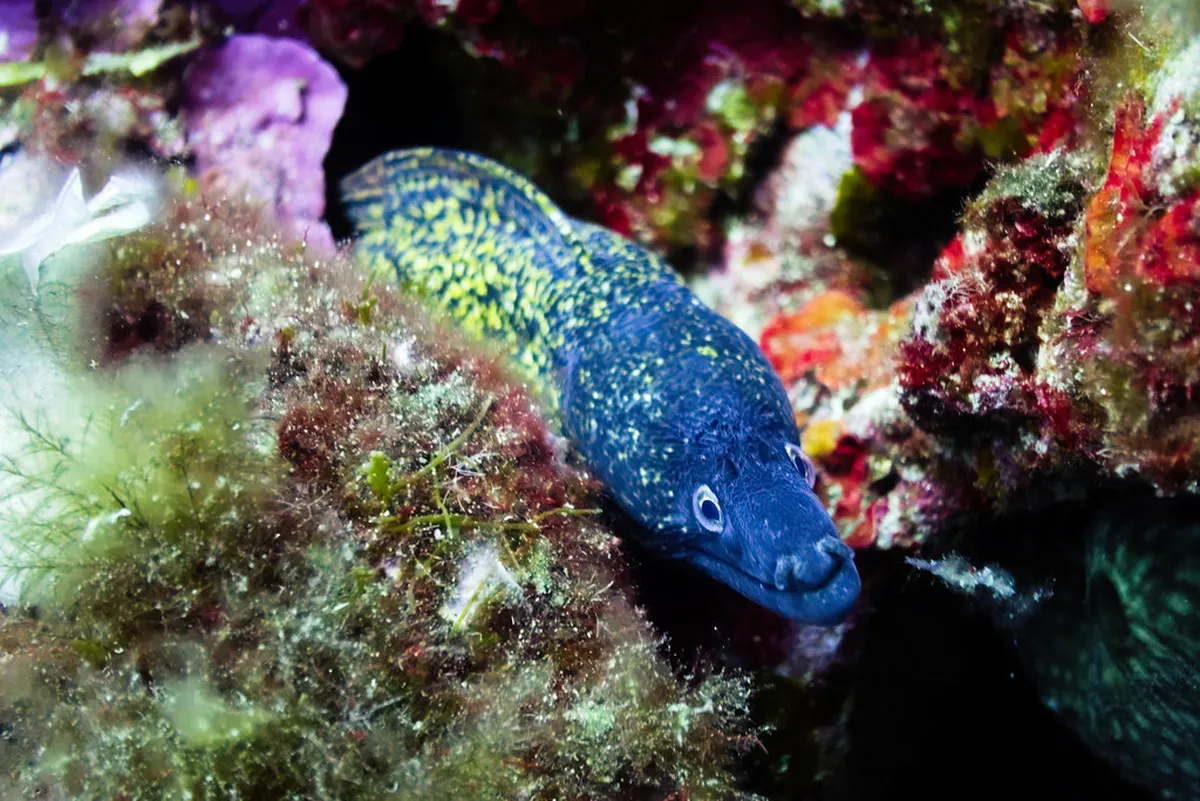
| Species | Size | ID cue | Habit |
|---|---|---|---|
| Giant moray (Gymnothorax javanicus) | Up to 10 ft (3 m), 66 lb (30 kg) | Gray-brown, black around the gill opening, leopard-like specks on the head | Large crevices and overhangs |
| Honeycomb or blackspotted moray (G. favagineus) | Up to 10 ft (3 m) | White to pale yellow with brown or black honeycomb blotches | Outer reef slopes; hides by day, hunts at night |
| White-eyed moray (G. thyrsoideus) | Up to 26 in (65 cm), usually 14 to 18 in | Gray head, pale white eyes, small dark speckles | Often shares a hole; groups of 3 to 5 reported |
| Yellow-edged moray (G. flavimarginatus) | Up to 8 ft (2.4 m) | Mottled yellowish body, yellow margin on the tail tip | Eats fish, including lionfish |
| Fimbriated moray (G. fimbriatus) | Up to 31 in (80 cm) | Cream body with dark spots, white mouth corners | Hidden by day, hunts at night |
| Zebra moray (Gymnomuraena zebra) | Up to 5 ft (1.5 m), usually 18 to 22 in | Tan to brown with narrow pale bars | Crushes crabs and urchins with blunt teeth |
| Snowflake moray (Echidna nebulosa) | Up to 3 ft (1 m), usually 20 to 28 in | Pale body, rows of black blotches, yellow eyes | Feeds day and night on crustaceans |
| Barred snake moray (Uropterygius fasciolatus) | Not given in our sources | Gray with dark bars, dark lines behind the eyes | Shallow reef, roughly 3 to 26 ft (1 to 8 m); uncommon |
Three Morays Most Divers Notice First
Giant morays are the heavyweights, and the largest moray by body mass. Their top-of-the-food-chain position matters for a reason covered in the food-safety section below. White-eyed morays are easy to ID because of their pale eyes. They tend to sit in shallower reef gaps and are more day-active than most. Honeycomb morays are the showpiece pattern. They are reclusive and often stay deep inside the reef during daylight, so a glimpse of the pattern is a good result.
Name confusion catches people out. The honeycomb moray is also sold as the blackspotted moray. Thai national park datasheets file the same species (Gymnothorax favagineus) as the laced moray. If a briefing mentions any of the three names, the Latin name settles it.
Where to See Moray Eels in Thailand
Sightings are best documented on the Andaman side. Coverage of the Gulf of Thailand is thin, so this guide does not extrapolate there. No site guarantees a particular species on a given dive. These are the sites operators and park datasheets tie to morays.
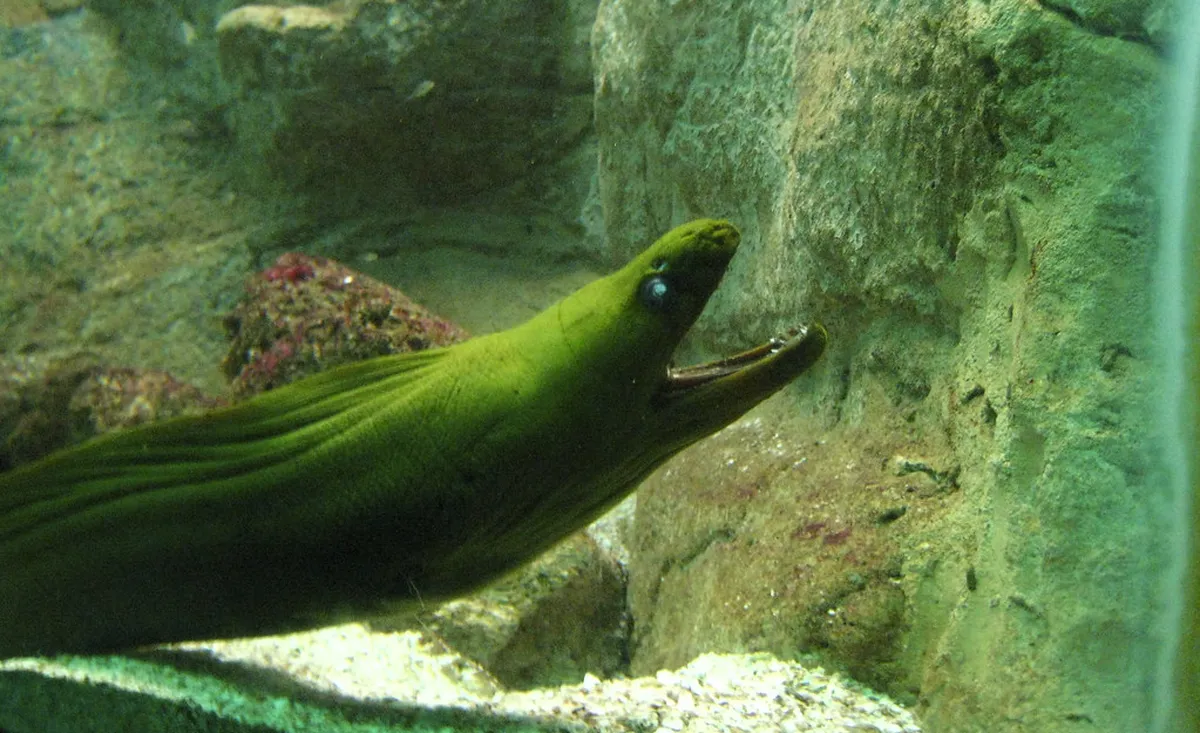
- Similan and Surin Islands: morays turn up at almost every site. Park datasheets name the Similans for the fimbriated moray.
- Boonsung Wreck: resident honeycomb and white-eyed morays are reported between the structure and the rubble.
- West of Eden: giant morays are reported in deeper crevices and current-exposed areas.
- Richelieu Rock: fimbriated morays are reported among dense reef, with some of the most varied sightings.
- Koh Haa near Koh Lanta: operators tag it with the most species, including giant, honeycomb, yellow-edged, zebra, snowflake, fimbriated and barred snake.
- Koh Bida and Anemone Reef near Koh Lanta: yellow-edged morays at Koh Bida, white-eyed at Anemone Reef.
- Tarutao National Marine Park: listed on the fimbriated moray's range map.
How to Choose: Liveaboard, Day Trip, Snorkel or Night Dive
Day boats leave from ports such as Phuket, Khao Lak, Krabi and Koh Lanta. Liveaboards cover the Similans and Surin. Prices change by season and operator, so compare quotes directly. The table ranks cost relatively and shows what each mode asks of you. Prices and hours checked November 2026 only in the sense that no operator rates are quoted here.
| Mode | Relative cost | Time | Certification | Moray odds |
|---|---|---|---|---|
| Liveaboard to Similan and Surin | Highest | Several days | Certified diver | Best: many sites in a row, night dives possible |
| Day-trip dive boat | Mid | One day | Certified diver | Good at named sites such as Koh Haa |
| Snorkel trip | Lowest | One day | None | Low: morays hide in crevices at depth |
| Night dive | Add-on to a dive trip | Evening | Certified diver and a briefing | High: morays leave shelters to hunt |
Best Time to See Morays and What Affects Visibility
Morays live on the reef year-round, so season mostly affects whether boats can reach the site. Andaman dive trips run in the high season, and monsoon weather closes or limits many trips. Similan park access follows a closure period set by the Department of National Parks. Check dates on the national parks department site before booking. For timing within a day, look at dusk and after dark. Fimbriated and honeycomb morays hunt at night, while white-eyed morays are more day-active. Zebra morays also hunt at night. Snowflake morays feed day and night.
Daytime dives suit white-eyed morays, and groups of 3 to 5 reported in one hole make a shared crevice worth a slow look.
Are Moray Eels Dangerous? Safe Diving and Snorkeling Rules
Morays are shy ambush predators, not hunters of divers. Bites typically happen when a moray feels cornered or mistakes a hand for food. Feeding makes this worse, because fed animals learn to link divers with prey. Bite wounds can still be serious, so respect the animal. Divers who want first-aid training can find it through Divers Alert Network. Compared with a venomous stonefish or a sea snake, a moray is a lower worry if you keep your hands to yourself.
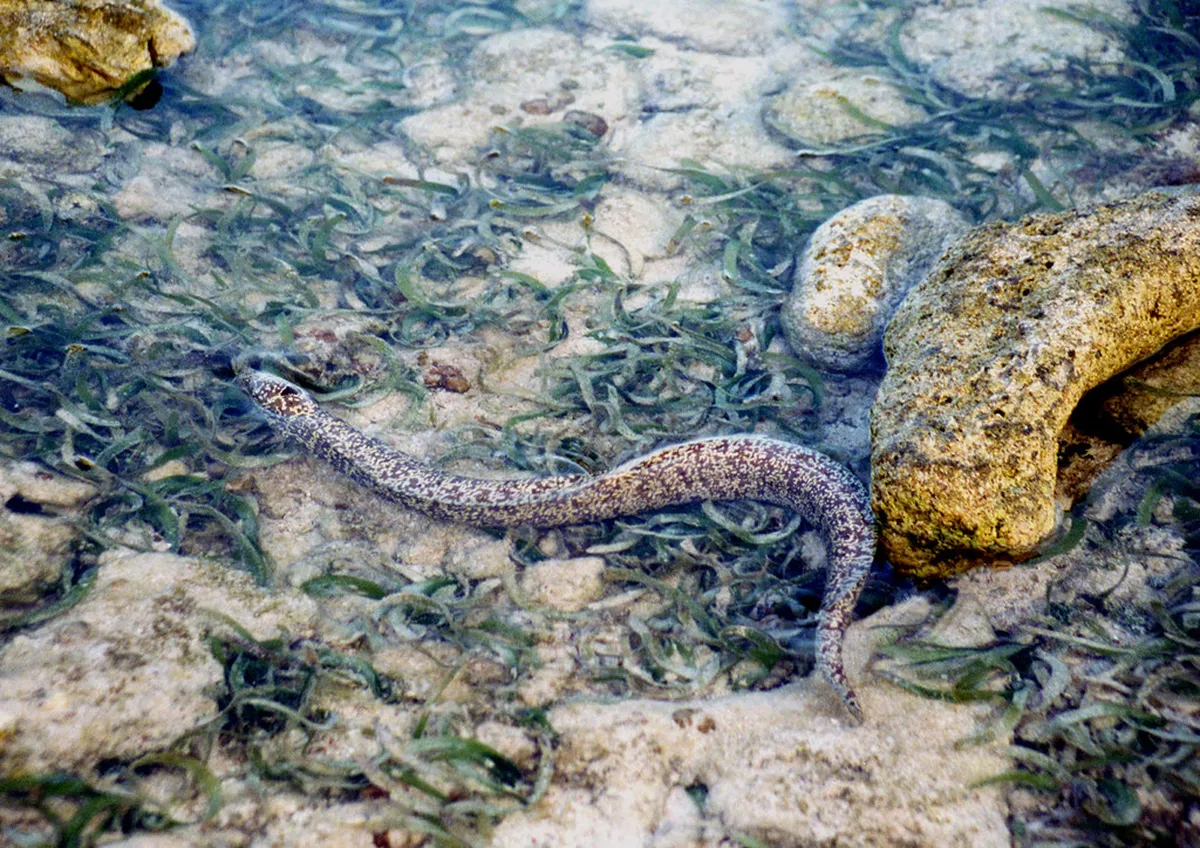
- Never feed a moray. Feeding is the clearest bite trigger.
- Keep your hands away from crevices and from the front of a head.
- Hover above or beside the eel, not directly in front of it.
- Hold neutral buoyancy so you do not brush the reef or the animal.
- Back off if the eel withdraws deeper. That means you are too close.
- Never chase, corner or touch an eel for a photo.
- Skip night dives without a proper briefing.
- Snorkelers: stay at the surface and look into crevices from a distance.
Moray Behavior Worth Knowing
Constant mouth opening and closing is breathing, not a threat. Morays pump water over gills this way. Their eyesight is poor and smell does the work, which is why a moving hand can read as prey. Deep in the throat sits a second set of jaws, the pharyngeal jaws, which pull prey down. Morays have been seen hunting with groupers, flushing prey from crevices. Their menu includes octopus, so check our octopus guide and cuttlefish guide for neighbors on the same dive. Yellow-edged morays eat lionfish, which you can read about in our lionfish guide. Other reef finds on the same dives include nudibranchs, seahorses and clownfish.
Moray vs Ciguatera: A Note on Eating Reef Fish
Giant morays are often ciguatoxic. They store toxins from other reef fish in their body fat, so eating one can poison you. Ciguatera risk applies to other large reef predators too, such as barracuda. Avoid ordering moray, and ask local staff about reef-fish advice. The Department of Marine and Coastal Resources is the Thai agency to ask. This is general information, not medical advice.
Giant morays can reach 66 lb (30 kg) and sit near the top of the reef food chain, so skip them on any Thai seafood menu.
Frequently Asked Questions
Are moray eels a fish?
Yes. Morays look like snakes, but they are bony fish that breathe through gills. The constant mouth movement pushes water over those gills.
What happens if I get bit by a moray eel?
Bites usually follow a hand placed near a head or an attempt to feed or touch the animal. Wounds can be deep, so get medical care promptly. Divers can find first-aid guidance through Divers Alert Network.
Notes for your next dive trip
Optional updates to our Thai diving guides.
You might also like

Continue reading
More guides you'll find useful