Stonefish in Thailand: Where They Live, Sting Risk and First Aid
Are stonefish dangerous in Thailand? Learn how to spot them, lower your sting risk at the beach and on reefs, and what first aid to give. Practical safety guide.
On this page
Last updated November 2026. Stonefish Thailand risk is real but low: these venomous reef fish live in Indo-Pacific waters, and stings mostly happen when someone steps on one. Prevention and hot-water first aid matter most, and this guide covers both.
Featured image: Bernard DUPONT, CC BY-SA 2.0, via Flickr.
What a stonefish is and how to spot one
Stonefish are a family of venomous fish found in coastal Indo-Pacific waters. Most people mean the reef stonefish, Synanceia verrucosa. It belongs to the same wider group as scorpionfish and lionfish. Our overview of marine life in Thailand covers the other animals you may meet on the same reefs.
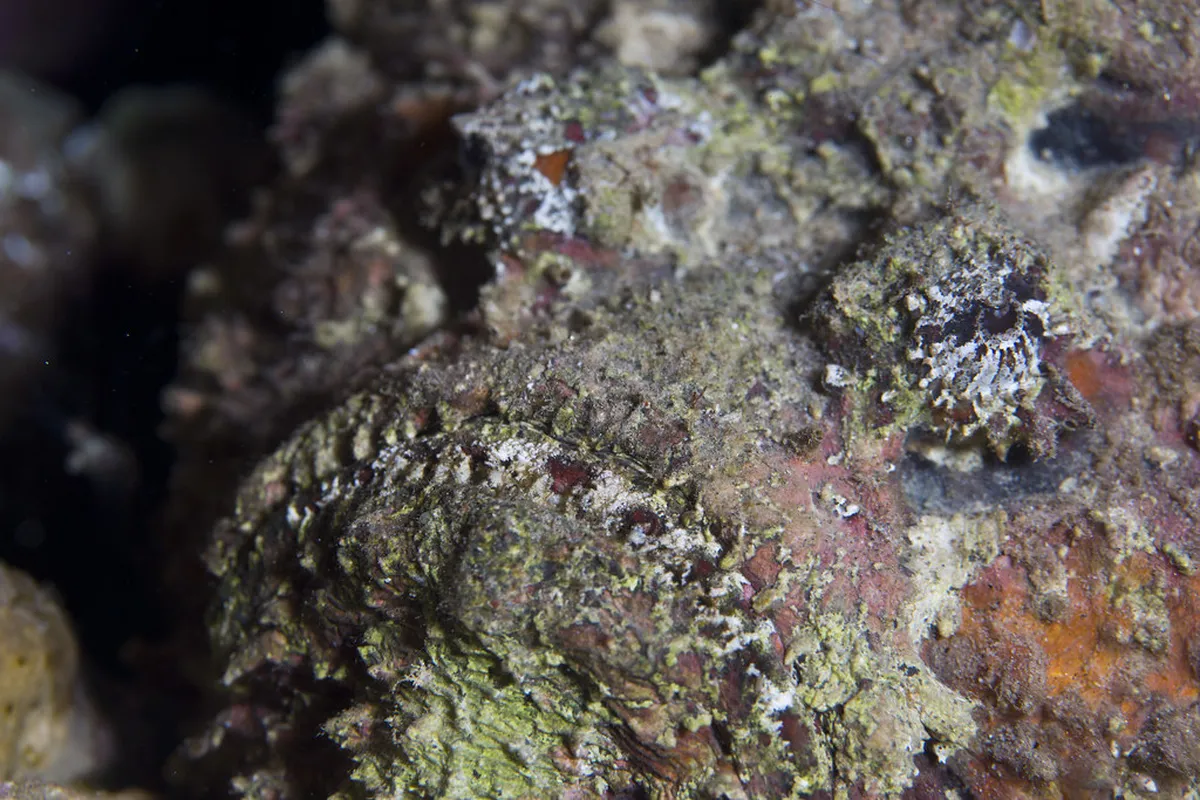
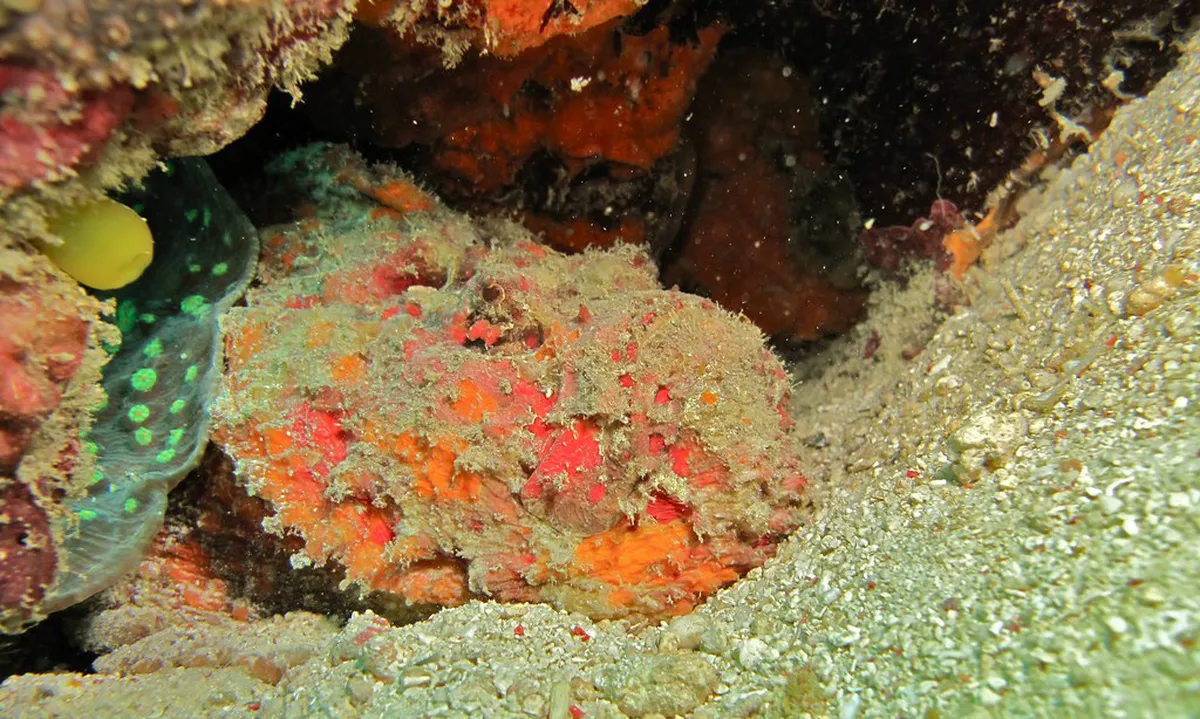
A reef stonefish can pass 16 inches (40 cm) in length. Size does not make it easy to find. Its body looks like a lump of rock or dead coral, often with wart-like growths on top. Colors range from dull gray and brown to orange, purple, pink and red, and these shades often match algae on rock.
Two features give it away. One is a large, upturned mouth. The other is a pair of slightly raised eyes, which stay visible even when the fish half-buries itself in sand. It rarely swims. It sits still and ambushes small fish and shrimp.
Look-alikes matter here. Scorpionfish are also camouflaged, but the upturned mouth helps separate a stonefish from them. Lionfish carry venom too, though they hover in the open with fanned fins. See our page on lionfish in Thai waters for that comparison.
The venom sits in 13 dorsal spines. Those spines are stiff enough to pierce a boot sole. A stonefish does not attack. It stings defensively when something presses on it.
- Large, upturned mouth
- Slightly raised eyes
- Rock-like body, sometimes with algae-coloured growths
- Rarely moves; sits on rubble, rock or reef
Where stonefish are found in Thailand
Stonefish are an Indo-Pacific reef species, so Thai reef waters are within their range. Risk follows the bottom type rather than a named beach. They favour rubble near the reef top or slope, usually shallower than 65 ft (20 m). They have been recorded as shallow as 3 ft (1 m), which is wading depth.
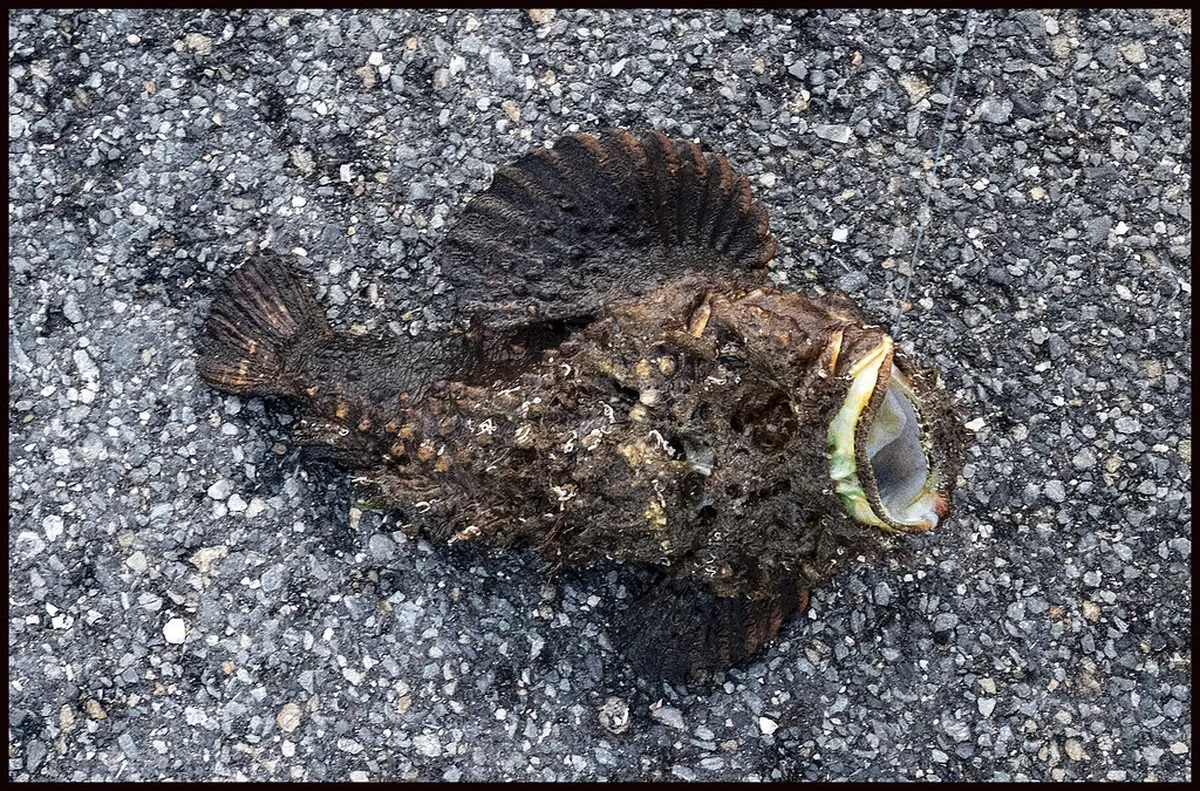
Seagrass is another hiding place. A stonefish can also dust itself with sand and leave only the eyes showing.
Koh Lipe is the clearest Thai example in published guidance. A Koh Lipe visitor guide reports stings where people stepped on a stonefish along a stretch of beach with a non-sandy bottom. That account involved barefoot walking, not diving.
No reliable source lists every Thai beach with stonefish, so treat any such list with suspicion. A safer rule is to judge the seabed in front of you. Clean sand is lower risk. Rock, rubble, coral fragments and seagrass are higher risk.
How likely is a stonefish Thailand sting? Risk by situation
Stings are rare but serious. The Koh Lipe guide mentions nearly one million visitors a year and says a Trang hospital sees two to three cases annually from the island. Those figures are anecdotal and unverified, so treat them as a rough sense of scale only.
One point surprises many beachgoers. A stonefish can survive out of water for up to 24 hours, so a sting can happen on the sand as well as in the sea.
Barefoot waders, reef-flat walkers, low-tide snorkelers and night swimmers face the most risk. Divers and swimmers over clean sand face less. The ratings below are our editorial judgement, not statistics.
| Situation | Risk level (editorial judgement) | What to do |
|---|---|---|
| Wading barefoot on rocky shoreline | High | Wear thick-soled shoes or stay out |
| Walking a reef flat at low tide | High | Skip it, or go with a guide who knows the spot |
| Snorkeling over rubble or seagrass | Moderate | Stay horizontal and do not stand up on the bottom |
| Night entries from a rocky shore | High | Use a sandy entry point and a torch |
| Swimming over clean sand | Lower | Shuffle your feet when walking in |
How to avoid a sting
Most prevention is cheap. Water shoes with thick soles help, but spines can still pierce sturdy footwear, so shoes reduce risk rather than remove it. Light, shuffling steps are better than heavy ones, because venom delivery is thought to rise with pressure on the spines.
Shuffle in the water and still take care on sand, because a stonefish can survive up to 24 hours out of water.

Never walk over seagrass. Do not step where the water is too cloudy to see the bottom. Never touch rocks or coral either, since the rock may be a fish.
Ask your resort or dive operator which sections of shore to avoid. Read any posted warnings. A guided snorkel costs more than going alone, but a guide knows local bottom types.
Stonefish are not the only stinging hazard on Thai coasts. Our guides cover box jellyfish and general jellyfish stings. Spiny risks include sea urchins in shallows. A stingray can also strike if stepped on. Read about the sea snake as well.
| Option | Cost | Protection | Trade-off |
|---|---|---|---|
| Thick water shoes | Low | Partial; spines can still pierce | Fit awkwardly with fins |
| Guided snorkel | Higher than going alone | Local knowledge of risky bottoms | Less flexibility, fixed sites |
| Skip rocky entries | Free | Avoids the highest-risk ground | Fewer places to swim |
What to do if you are stung: first aid and hospital care
This is general information, not medical advice. Any suspected stonefish sting needs urgent care.

Stonefish stings cause severe pain almost at once. Shock, nausea and local tissue damage can follow. Get out of the water and call for help immediately. Ask a resort or restaurant for hot water straight away.
Immerse the stung area in water as hot as the person can tolerate without scalding. Sources cite temperatures of at least 45 °C (113 °F), and heat is thought to break down the venom. Exact timing varies, so follow a doctor's instruction.
Go to a clinic or hospital even if the pain eases. Doctors can give local anesthesia for pain. Only trained staff can give antivenom, and that is a hospital decision for severe cases. Skip folk remedies with no medical backing.
- Leave the water and call for help
- Immerse the area in water as hot as tolerable without scalding
- Do not cut, suck or tie off the wound
- Get to a clinic or hospital quickly
Getting medical help on Thai islands
A Koh Lipe account describes a clinic visit followed by transfer to a hospital in Trang on the mainland. Routes, costs and travel times differ by island, so ask your accommodation before you swim and check that your insurance covers evacuation, with extra guidance from Divers Alert Network.
Seeing a stonefish safely: divers and snorkelers
Divers and snorkelers do see stonefish, often on rubble patches near the reef top. Snorkelers have as good a chance as divers. Luck and close attention to every nook decide it.
Snorkelers face the same odds as divers on rubble near the reef top, usually shallower than 65 ft (20 m).
Keep your distance and never touch the animal. Do not move it for a photo. Keep neutral buoyancy near rubble, and check the sand below you before resting a hand or knee on it. Look for the eyes if a patch of sand seems odd.
Marine curiosities beyond stonefish include moray eels, nudibranchs and the octopus, all best enjoyed without touching.
Frequently Asked Questions
Do stone fish live in Thailand?
Yes. Stonefish are an Indo-Pacific reef species, and Thai reef waters fall inside that range. Koh Lipe is the best-documented Thai example. Risk depends on the bottom type, with rubble, rock and seagrass the likeliest hiding places.
Are stonefish venomous?
Yes. Venom sits in 13 dorsal spines, and a sting causes severe pain. Hot water and urgent medical care are the standard response. Antivenom is reserved for serious cases and is given only by trained medical staff.
Notes for your next dive trip
Optional updates to our Thai diving guides.
You might also like

Continue reading
More guides you'll find useful