Titan Triggerfish in Thailand: Where to See Them, Stay Safe
Titan triggerfish are territorial reef fish, not hunters. Learn how to spot one in Thailand, the cone rule, and what to do if it charges.
On this page
Last updated November 2026. A titan triggerfish defends a nest, it does not hunt people, and the one rule is to move sideways, never up. This guide explains how to recognize the species, where Thai divers report it, and how to react if one charges. It is one of many animals in our Thailand marine life guide.
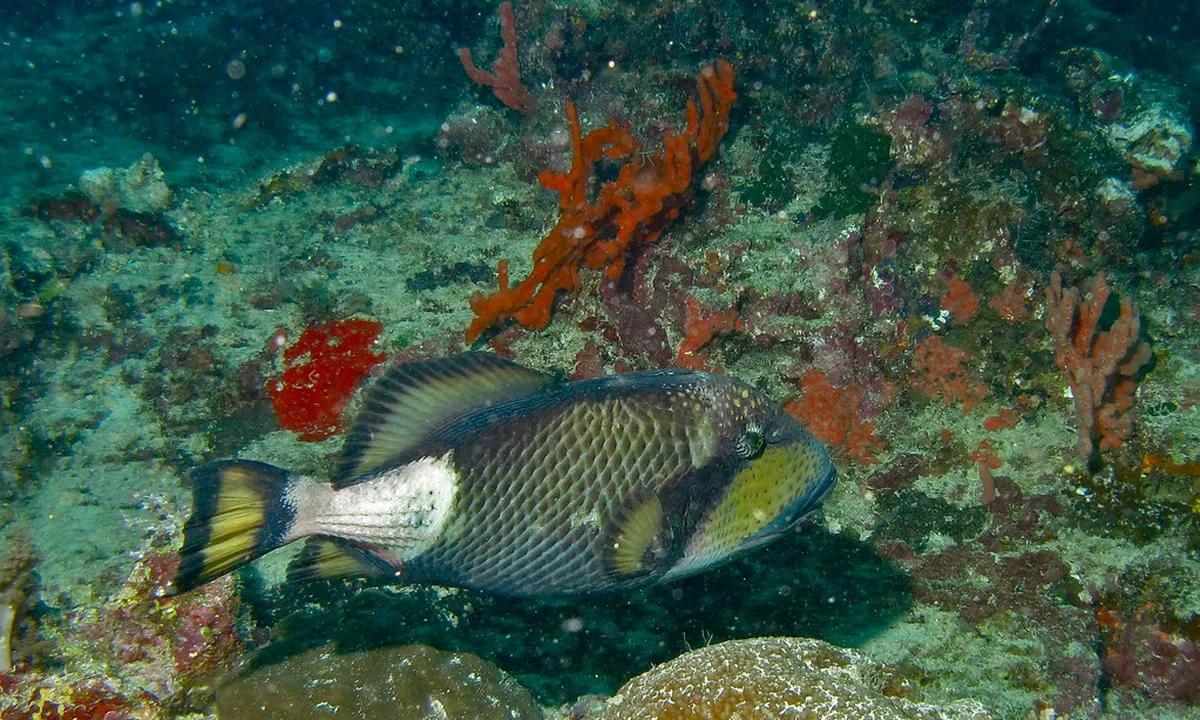
Featured image: Bernard DUPONT, CC BY-SA 2.0, via Flickr.
Titan triggerfish at a glance
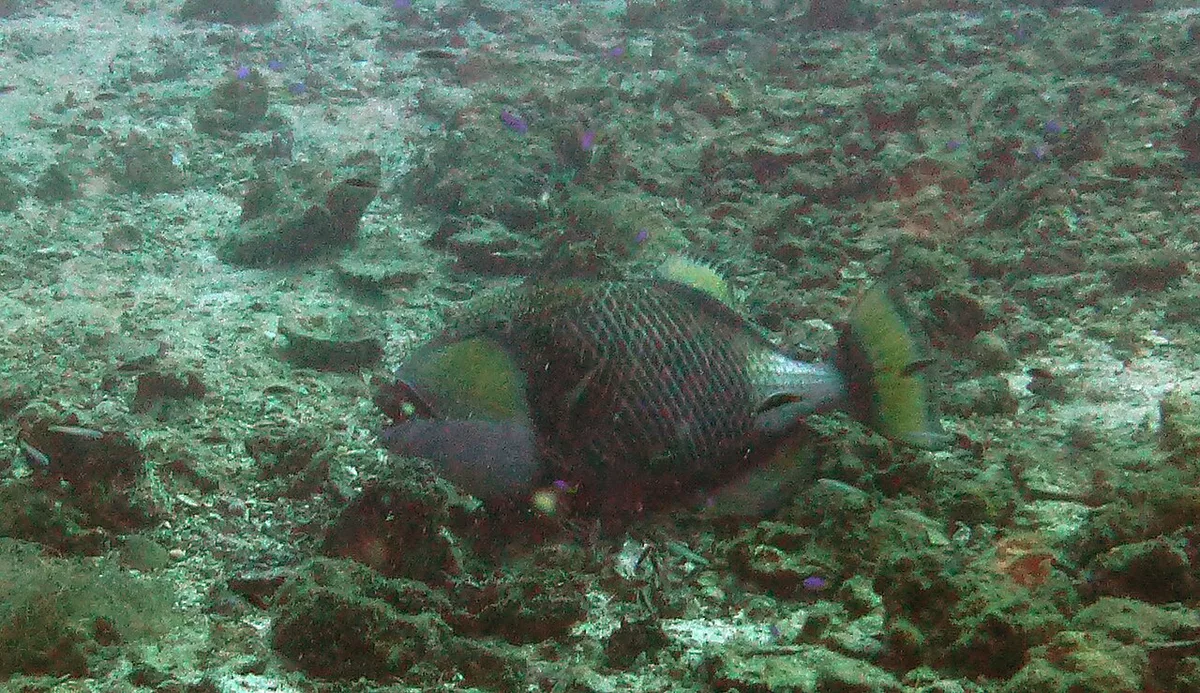
Balistoides viridescens is a large, solitary reef fish of the Indo-Pacific. Thailand is among its recorded range countries. It lives on coral reefs and is a daytime animal that sleeps at night. Most Thai encounters happen near its nest, which is usually on a flat sandy patch among the corals. A fish guarding that patch will swim up close to warn you away. That is defense, not hunting. For the wider cast of reef life you may meet, start with our marine life hub. For conservation status, check the current entry on the IUCN Red List.
- Scientific name: Balistoides viridescens
- Size: up to about 30 inches (75 cm)
- Weight: up to about 22 lb (10 kg)
- Lifespan: roughly 10 to 15 years
- Jaws: powerful teeth built to crush coral and shells
- Behavior: territorial, most of all when nesting
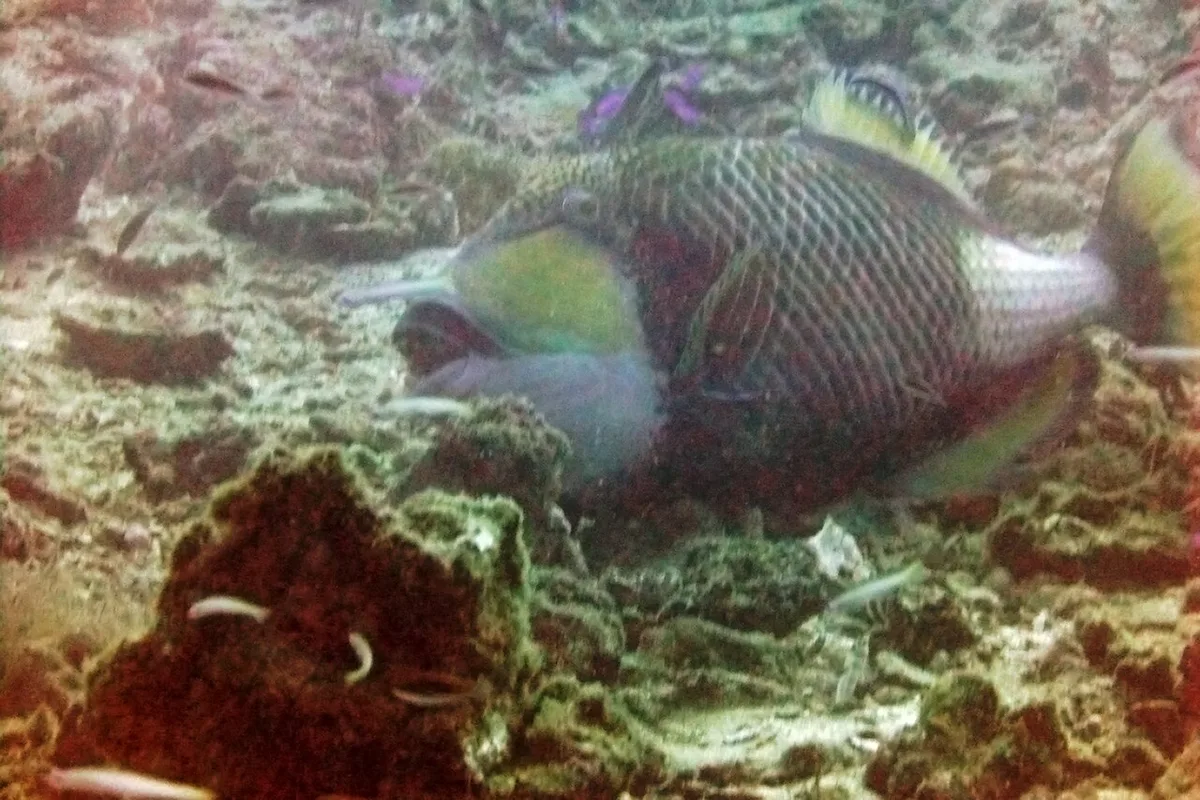
How to recognize one
Adults reach about 30 inches, so they look heavy-bodied next to most reef fish. Dark markings above the mouth look like a moustache. That is why some divers call it the moustached triggerfish. Dark edging on the fins gives it another nickname, the black-tipped triggerfish. Smaller triggerfish and other reef fish can look similar from a distance. Look for the size, the facial markings and the dark fin edges together. Coral-grazing parrotfish share the reef but behave very differently.
Why it charges: nest defense and the cone rule
A titan triggerfish guards its nest against anything it sees as an intruder. Breeding time is the most aggressive period. Exact nesting months in Thai waters vary by site, so ask your dive guide what is happening locally. The defended zone is shaped like a cone that widens toward the surface. Swimming up only carries you deeper into the fish's territory. The reliable exit is horizontal, away from the nest. Stay calm and keep your movements smooth.
- Move sideways, level with the seabed, and leave the area.
- Do not kick upward or race for the surface.
- Keep movements smooth and avoid thrashing.
- Give the nest a wide berth for the rest of the dive.
- Tell your guide so other divers can avoid the spot.
Where to see titan triggerfish in Thailand
Local operators on Koh Chang report titan triggerfish at several sites. Their most popular reef for the species is Hin Raab South, at roughly 16 to 50 ft (5 to 15 m). These are operator reports, so ask a dive shop which sites currently have active nests. Other Thai regions may also hold the species, but this guide lists only sites that operators have named. Check Thai marine park rules and fees with the Department of National Parks before you go.
Hin Raab South sits at 16 to 50 ft (5 to 15 m), so a diver who drifts sideways along the bottom can leave the cone without rising.
| Hin Raab South | Main area for the species around Koh Chang | About 16 to 50 ft (5 to 15 m) | Certified divers | Operator-reported |
| HTMS Chang Wreck | Fish commonly seen in sandy areas around the wreck | Sandy ground by the wreck | Certified divers | Operator-reported |
| Hin Luk Bat | Many fish hiding between large coral blocks | Large coral blocks | Certified divers | Operator-reported |
Diver vs. snorkeler: who should worry?
Both groups can meet a guarding fish, but the risk differs. Snorkelers float directly above shallow sandy patches, which is where nests tend to sit. A swimmer who panics and kicks upward stays inside the cone. Divers can usually drift sideways along the bottom and out of the zone. If you snorkel, stay horizontal and swim away across the surface, not toward it. Book small-group guided trips and listen to the briefing. Ask the guide whether any nesting fish are known at the site. Decline a spot where a fish is already acting aggressively.
Bite risk and first aid
A bite is possible, and the jaws are strong. Unprovoked attacks are rare, and nearly all incidents involve someone near a nest. Fins, hands and limbs are the usual targets. Some divers report fish nipping at bright yellow fins. If you are bitten, leave the water and wash the wound with clean water. Cover it and see a clinic, especially if it is deep or bleeding heavily. The Divers Alert Network offers dive injury guidance. Other reef animals also deserve space, including the moray eel and the lionfish. Read about the stonefish before you wade into shallows.
What they eat and why it matters on the reef
Titan triggerfish eat hard corals, shellfish, crustaceans, urchins and algae. Their teeth crack shells that most fish cannot open. That feeding keeps invertebrate numbers in check on the reef. Learn how one of their prey animals lives in our sea urchin guide. Watch from a distance and keep your fins off the coral. A fish that is busy feeding is not defending a nest.
Notes for your next dive trip
Optional updates to our Thai diving guides.
You might also like

Continue reading
More guides you'll find useful