PADI Open Water in Thailand: Cost, Days & Where to Go
How the PADI Open Water course works in Thailand: days, structure, swim test, age rules, what to ask shops, and where to learn.
On this page
Last updated November 2026: PADI Open Water Thailand courses certify you to dive with a buddy to 18 m, and schools usually run them over about 3 days. Koh Tao is the best-known training hub, but the right format depends on your time, budget and comfort in water. We cover the structure, requirements, costs and booking questions so you can choose without a sales pitch.
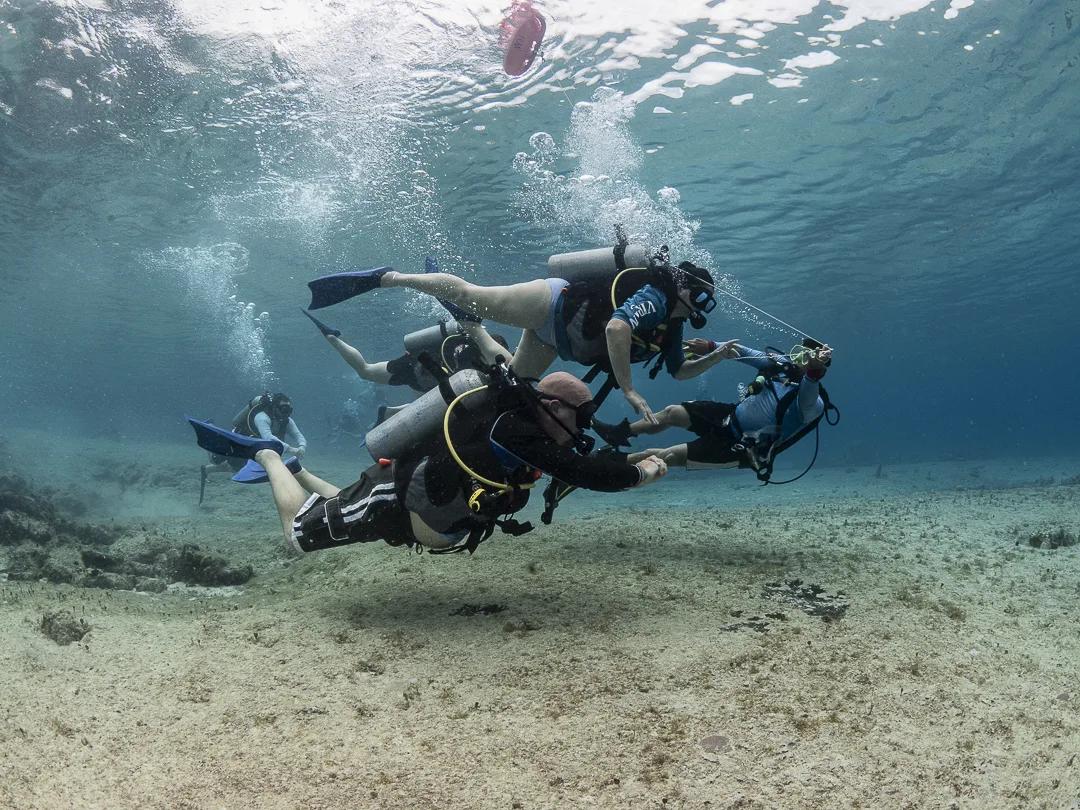
Featured image (an instructor with students outside Thailand, shown for illustration): Sand Dollar Sports, CC BY 4.0, via Wikimedia Commons.
PADI Open Water in Thailand: The Short Answer
PADI Open Water Diver is the entry-level certification for independent diving. It qualifies you to dive with another certified diver to 18 m (60 ft). Training has three parts: knowledge development, confined water, and four open water dives. Thai schools typically schedule it over 2.5 to 3½ days. Koh Tao is the best-known base, and other Thai islands and coasts also run the course. Our rule is simple. With three full days, take Open Water. With fewer, take Scuba Diver and upgrade later. For agency choices beyond PADI, start with our overview of certification options in Thailand.
What You Get: Depth Limits and Certification Rules
Certification lets you dive to 18 m with another certified diver, anywhere in the world. During training, Dives 1 and 2 stay within 12 m. Divers aged 10 and 11 keep a 12 m limit until they turn 12. Scuba Diver is a lower rung. It caps you at 12 m and requires a PADI professional with you. Neither card means every site is suitable. Stay inside your training and the dive plan, and add experience before pushing depth.
How the Course Works: Theory, Pool and Four Ocean Dives
Part one is knowledge development, usually through PADI eLearning. Theory runs in five sections, each ending with a 10-question quiz. A 50-question multiple-choice final exam follows, with a 75% pass mark. Part two is confined water, in a pool or a sheltered bay. One Koh Tao school runs five confined water dives and ends them with a mini dive that rehearses a full ocean dive. Part three is four open water dives, often spread over three to four dive sites. Dive 4 is the certification dive. Most required skills are usually finished by Dive 3. A sample three-day layout from one Koh Tao school with an on-site pool:

- Before arrival: PADI eLearning in your own language.
- Day 1: pool training, 09:00 to around 16:00, with a lunch break.
- Day 2: Dives 1 and 2 from the beach, 09:00 to around 13:00.
- Day 3: boat departs 07:30 for Dives 3 and 4, back around 13:00.
Requirements: Age, Swim Test and Medical Form
You can start from age 10. Junior Open Water applies to younger divers, but schools quote different upper ages. One Koh Tao school says 10 to 14, another says 10 to 15. Use PADI's current figure, and read our notes on age rules for young divers. The water skills test has two parts. First comes a continuous 200 m swim, or a 300 m snorkel swim with mask, fins and snorkel. There is no time limit. Second comes a 10-minute float or tread in water too deep to stand. Strokes and floating style are your choice. The medical form has 10 yes/no questions. A single "yes" leads to extra questions and may need a physician's sign-off. One school says it can arrange a physician on Koh Tao. If you answer "yes" to anything, we'd get sign-off at home before you fly. Ear equalisation is practiced in the pool. DAN's diver safety resources are a useful second opinion on fitness questions.
How Long It Takes and How to Schedule It
Published schedules differ. One Koh Tao school lists 2.5 days, another lists 3 days, and a third lists 3½ days. The gap comes mostly from where theory happens and how pool and ocean sessions are packed. Courses are performance-based, so a skill you have not mastered earns extra time, not a pass. Allow a spare day in your plan. Doing eLearning at home moves theory off your holiday. One school says this often lets students finish in under 4 days. The trade-off is evenings of study before you travel.
- eLearning at home: saves island time, but you study before the trip.
- eLearning on the island: no homework, but it costs part of a day.
- Longer pace (3½ days): more time per skill, fewer rushed sessions.
- Compressed pace (2.5 days): fits tight itineraries, with little buffer.
What It Costs and What's Included
Prices and hours checked November 2026. Treat the figures below as one shop's examples, not market rates. One Koh Tao school lists the three-day Open Water course at ฿10,900, course only. It lists ฿9,500 for guests staying at its hostel. That price includes eLearning, a pool session, four open water dives and a maximum of 4 students per instructor. Optional photography on one dive costs ฿1,500 there. For comparison, another school lists the 2-day Scuba Diver course at ฿8,500. A five-day Open Water plus Advanced package at the first school is ฿19,000 course-only. Build your own worksheet from the rows below.

| Cost line | What to ask |
|---|---|
| Course fee | Does it include eLearning, certification fee and all gear? |
| Boat or beach dives | Are all four ocean dives covered? |
| Pool | On-site pool, or confined water in the sea? |
| Extra days | Price per added day if a skill needs more time |
| Accommodation | Free nights, discount, or separate booking? |
| Photos | Optional, and per dive or per day? |
| Next course | Advanced Open Water price if bundled |
Open Water vs Scuba Diver vs Discover Scuba Diving
Pick by time, not ambition. Scuba Diver certifies you to 12 m with a PADI professional. One school says you can upgrade later at any PADI center with extra theory, skills and two more open water dives. Open Water adds the 18 m buddy certification and two more ocean dives. Discover Scuba Diving is a one-day experience, not a certification. Our rule: under three full days, Scuba Diver; otherwise Open Water.
| Option | Depth | Supervision | Days | Upgrade | Best for |
|---|---|---|---|---|---|
| Open Water Diver | 18 m | With a certified buddy | About 2.5 to 3½ | Advanced Open Water | Three or more free days |
| Scuba Diver | 12 m | PADI professional only | About 2 | To Open Water | Short trips |
| Discover Scuba Diving | Ask the school | Instructor throughout | 1 | Counts as a taster only | Trying it first |
Where to Take the Course in Thailand
Koh Tao dominates course listings. One school counts over 25 dive sites around the island and short boat trips between them. Other Thai bases also run Open Water, including Phuket, Koh Phi Phi, Koh Lanta, Khao Lak and Pattaya. Thailand has dive sites on both its west and east coasts, so conditions differ by base. We compare bases by site types, group sizes and season in our guide to the 5 Best Places to Learn to Dive in Thailand (By Season).
Best Time to Learn and Conditions
Season matters because monsoon weather changes sea state and visibility, and the two coasts do not behave alike. Choose your base and your dates together. Get dates from official sources such as the Tourism Authority of Thailand and the Thai Meteorological Department. Shop marketing may call diving year-round. Weather can still cancel a boat day, so ask each school how it handles rebooking.
How to Choose a Dive School: Questions to Ask and Red Flags
Compare schools on training quality and safety before price. Ask these before you pay:
- What is the maximum number of students per instructor?
- Does the price include eLearning, gear, certification fee and transport?
- Is confined water in a pool or in the sea?
- Is the medical form required before you start?
- What happens if weather cancels a dive?
- Who is my instructor, and what is their PADI status?
- What is the cost of an extra day if I need more time?
- Red flag: a very cheap bundle with fees added at checkout.
- Red flag: large groups or rushed sessions.
- Red flag: pressure to buy gear or the next course on day one.
Common Mistakes and How to Avoid Them
Booking on price alone is the usual error. A low headline fee can leave out gear, certification or the boat. Skipping the medical form until arrival risks losing a day to a clinic visit. Another mistake is compressing the course into fewer days than your skills need. Leave one spare day. Last, avoid buying gear on day one. Finish the course first and decide with buoyancy and fit experience.
Sort the 10 yes/no questions before you fly, since a single yes can need a physician's sign-off.
After Certification: What Comes Next
Many divers continue straight to PADI Advanced Open Water. Our guide to Advanced Open Water in Thailand covers where to take it. Rescue Diver usually follows. If you are weighing agencies, read our comparison of PADI versus SSI. Longer-term, professional routes exist. See Divemaster training in Thailand. We also cover a Divemaster internship. Instructor candidates should read about the PADI Instructor Development Course.
Notes for your next dive trip
Optional updates to our Thai diving guides.
You might also like

Continue reading
More guides you'll find useful