Divemaster Internship Thailand: Cost, Length and How to Choose
Thinking of a divemaster internship in Thailand? Compare what's included, how long it takes, prerequisites, living costs and how to choose a dive center.
On this page
Last updated November 2026. A divemaster internship in Thailand is a PADI Divemaster program where you train on the job inside a dive center's team instead of sitting in a classroom. One Koh Tao center lists 21-42 days and ฿48,000 for training, dives, PADI materials and the internship period. Dive count and prerequisites decide whether you qualify, and time and budget decide whether it suits you.
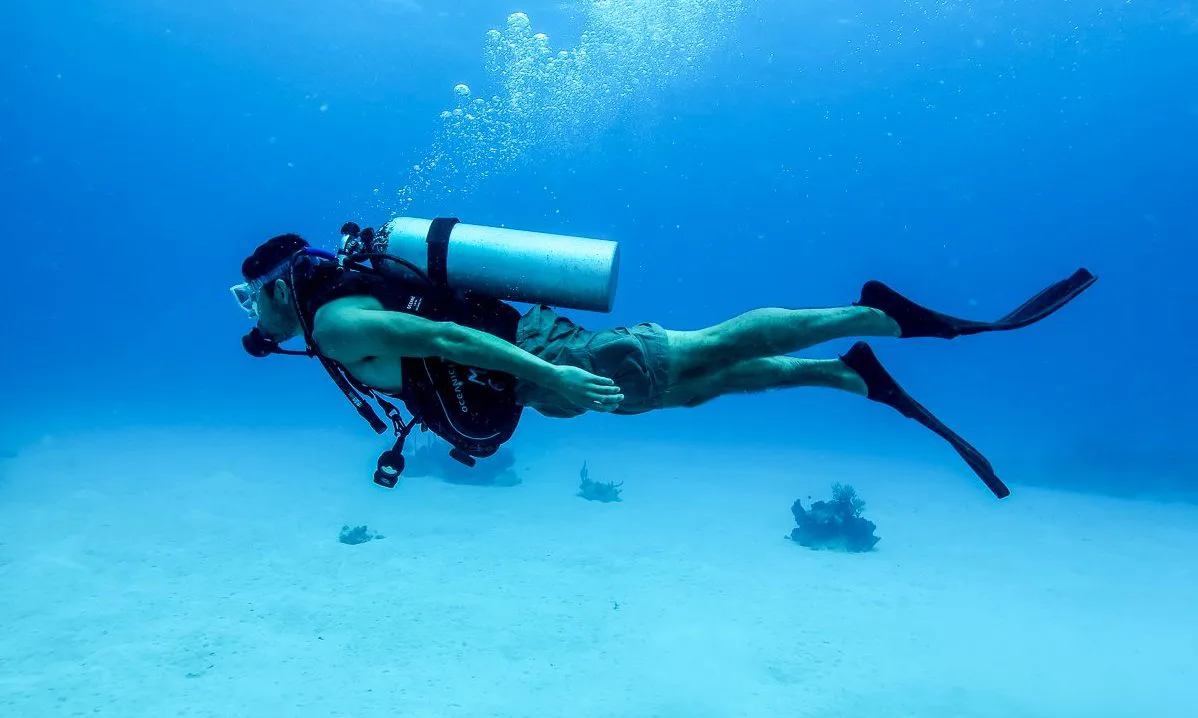
Featured image (a diver in the US Virgin Islands, shown for illustration): Summitandbeach, CC BY-SA 4.0, via Wikimedia Commons.
Divemaster internship in Thailand: what it is and how it differs from a course
Divemaster is PADI's first professional rating. Certified divers can lead guided dives, assist instructors on courses and work at dive centers. PADI publishes the official outline on its Divemaster course page.
An internship changes the delivery, not the credential. You join the center's team and learn from instructors while real students are in the water. Theory covers physics, physiology, equipment and the dive environment. Practical work covers PADI's 24 core skills, assisting on Open Water and other courses, leading supervised dives, emergency scenarios and mapping a dive site.
A plain course can compress those parts into a fixed block. For the course itself, read our Divemaster course guide. Koh Tao is the best-documented hub for internships. Offerings on other Thai islands vary, so ask each center for its own course schedule.
Entry requirements: are you ready?
One Koh Tao center sets four entry requirements. Check them against PADI's current standards before you book.
You need Rescue Diver or an equivalent from another agency. You need EFR (first aid) completed within the last 24 months. You need at least 40 logged dives and must be 18 or older. Our scuba diving age limit guide explains the age rules for younger divers.
Missing Rescue or EFR is fixable. That center offers Rescue for ฿11,000 and EFR for ฿5,000 before the internship starts. Compare those add-ons when you compare quotes.
- Open Water: start with our Open Water in Thailand guide.
- Advanced Open Water: see our Advanced course guide.
- Rescue Diver plus EFR within 24 months.
- Divemaster, with 40+ logged dives at that center.
- IDC, the instructor course that follows.
- If you are still mapping the ladder, our certification overview shows every step.
How long it takes and why rushing backfires
One center advertises 21-42 days at your own pace. Another Koh Tao package is pitched at 2 months. Neither number is a Thailand-wide norm.
Time matters because the job is experience. More weeks mean more student groups, more teaching styles and more changing conditions. A two-week sprint can leave too few real courses to assist on. That same center sets 21 days as its minimum for that reason.
Ask each center these questions instead of chasing the shortest option:
- How many courses will be running during my dates?
- How many of those can I assist on?
- How many dives will I lead myself?
- What happens if I need extra days?
What's included in the price (and what usually isn't)
Prices and hours checked November 2026. One Koh Tao center charges ฿48,000. That covers all training and dives, PADI materials (the Crew Pack) and the internship period.
If Rescue or EFR is missing, a Koh Tao center offers Rescue for ฿11,000 and EFR for ฿5,000 before the internship starts.

That same center says its PADI certification fee, about 286 AUD, is paid separately. It says this is common on Koh Tao. It also notes that PADI materials cost another ฿8,000-10,000 at some centers, so check whether a cheaper quote leaves them out.
Accommodation and food are extra. A monthly room on the island runs about ฿8,000-15,000 at that center. For long stays, check current Thai immigration rules.
That center also says an internship in the Caribbean or Australia can cost another 2,000-3,000 USD. Use the table to build your own total. Fill each blank from written quotes.
| Line item | Ask the center | Example from one Koh Tao center |
|---|---|---|
| Training and dives | Included? How many dives? | Included in ฿48,000 |
| PADI materials | Crew Pack included? | Included; ฿8,000-10,000 extra elsewhere |
| Internship period | Separate fee? | Included |
| PADI certification fee | Who pays, and when? | About 286 AUD, paid separately |
| Rescue and EFR if missing | Price and timing? | ฿11,000 and ฿5,000 |
| Accommodation | Monthly rate? Deposit? | Room about ฿8,000-15,000 a month |
| Food and insurance | Cost per week? Cover required? | Your own cost; ask about dive accident cover such as DAN |
| Extension or cancellation | Fee for extra days? | Ask |
A typical day and what's expected of interns
Mornings are on the boat. You help students with gear and on the dive, then debrief on the way back. Afternoons bring a second dive, a theory session or hands-on practice. Evenings are for filling in your dive log and studying.
Your role is to learn, observe and assist. Do not explain skills or correct students unless the instructor asks. Save questions for when the instructor is not teaching, unless safety is involved. If you disagree, talk to the instructor afterwards, never in front of students.
Water skills tests worry some candidates. One center lists a 400 m swim, an 800 m snorkel, a 100 m tow of an "unconscious" diver and a 15-minute float. It says you train up to them gradually, so you do not need to be an athlete. Confirm the exact standards with your center and PADI.
How to choose a dive center for an internship
Price alone is a weak filter. Verify PADI 5 Star IDC status on PADI's own site. Then put the same questions to every center in writing.
Start wider with our guide to learning to dive in Thailand. If you are weighing another agency, read PADI versus SSI first. The SSI site lists that agency's professional route.
- Is the center a verifiable PADI 5 Star IDC center?
- What is the instructor-to-intern ratio?
- How many courses run in your season?
- Will you lead dives, or only follow?
- Is every fee written down, including the certification fee?
- How is accommodation arranged, and who sets the rate?
- What are the extension and cancellation terms?
- Can you continue to the PADI IDC in Thailand at the same place?
- Mistakes to avoid: rushing, comparing quotes with different inclusions, leaving Rescue and EFR timing late, and choosing on price alone.
Is it worth it? Career and cost trade-offs
Divemaster qualifies you to lead certified divers and assist instructors. One center lists Divemaster work in Southeast Asia, the Red Sea, the Maldives, the Caribbean and Australia. Pay and job availability vary by season and employer, so research them directly rather than expecting a promise.
Caribbean or Australia internships may cost 2,000-3,000 USD more, while Divemaster work is also listed in Southeast Asia and the Red Sea.
The internship trade-off is simple. You pay for weeks of living costs, but you gain supervised experience with real classes. A standalone course can cost less up front. It may leave you with fewer courses assisted and fewer dives led. If you plan to teach, the IDC is the usual next step.
Notes for your next dive trip
Optional updates to our Thai diving guides.
You might also like

Continue reading
More guides you'll find useful