King Cruiser Wreck Phuket: Depth, Certification & How to Dive It
Plan the King Cruiser Wreck dive in Phuket. Depth, certification, current, marine life, and how to choose a trip. Check conditions before you go.
On this page
Last updated November 2026: the king cruiser wreck is an 85 m car ferry that sank in 1997 after hitting Anemone Reef, east of Phuket and west of Phi Phi. Reports put the top at 16–18 m (52–59 ft) and the sand at roughly 30–33 m (98–108 ft), so operators list it for Advanced Open Water divers. Boats reach it on day trips from Phuket, and you can weigh other options by comparing sites around Phuket.
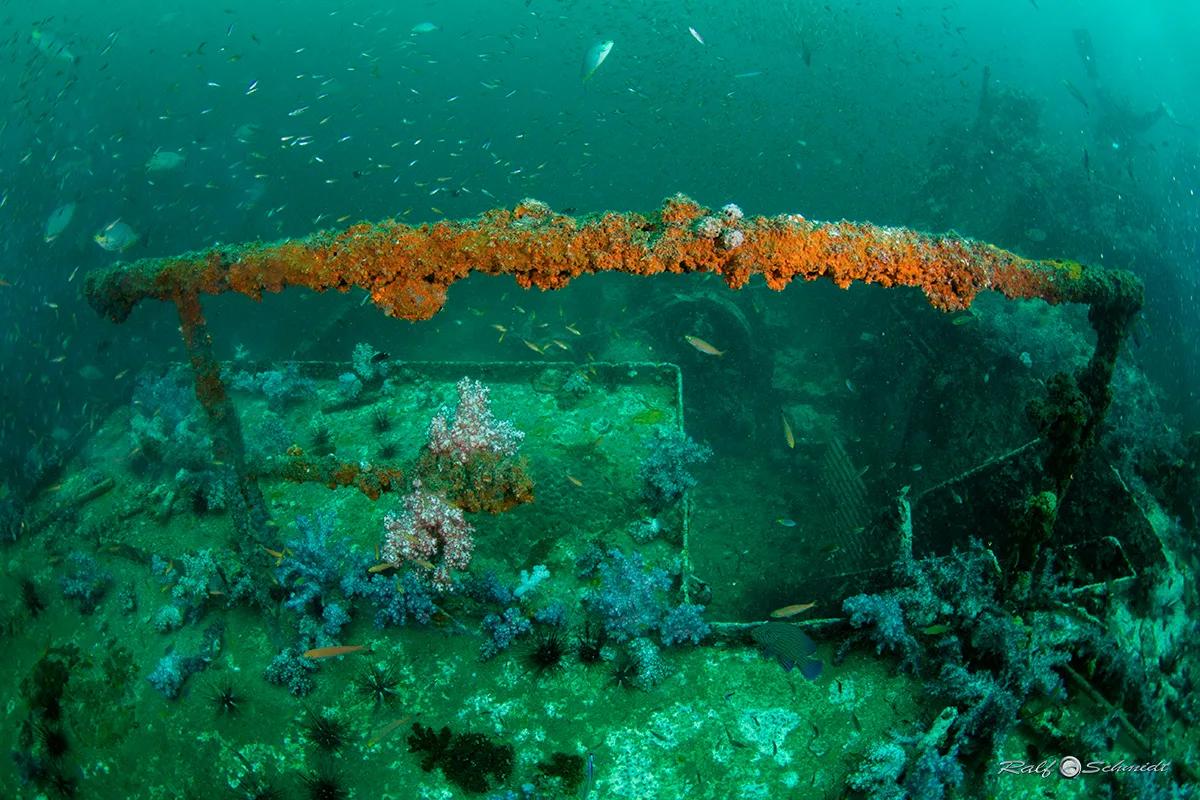
Featured image: Ralf Schmidt, CC BY-SA 3.0, via Wikimedia Commons.
Quick answer: what the King Cruiser wreck is
King Cruiser is Phuket's best-known wreck dive. Operators run it as a deep, current-affected dive that suits divers with Advanced Open Water or an equivalent. Most trips treat it as the first dive of a three-dive day so divers get the best gas and no-decompression time. Structure is decaying, so you swim around the hull rather than through it.
- Vessel: steel car and passenger ferry, about 85 m long and 25 m wide
- Depth: roughly 16–18 m at the top to 30–33 m on the sand
- Certification: Advanced Open Water or equivalent
- Main caveats: medium to strong current, variable visibility, collapsed decks, boat traffic
How the King Cruiser sank
King Cruiser began as a car and passenger ferry built in Japan in the early 1990s. A Thai company ran it between Phuket and the Phi Phi islands. On 4 May 1997 it struck the reef where it grounded, and the rock tore into the hull. Passengers and crew reportedly left safely, and one operator says the ship went down about 4 hours later. Passenger estimates run past 500, though figures differ by account. Rumours about the cause circulate among divers, from insurance trouble to paid captains. None is proven. One operator account says a court found the captain negligent. For you, the useful fact is simpler: a ferry that stayed afloat for hours now sits on the seabed as an artificial reef.
King Cruiser wreck dive facts: depth, visibility and current
Published figures disagree, so treat every number below as a range and listen to your briefing. Reports put the top of the wreck at 16 m or 18 m. The sand bottom is reported at 30–33 m, and one operator notes it shifts with the tide. Average depth along the outer hull is reported at 22–26 m. Visibility claims range from 5 m to 30 m. A 2016 visitor described cloudy water and too many boats at once. Operators describe the current as medium to strong. Penetration is not recommended because decks and ceilings have collapsed. One operator reported losing a large part of the bow in September 2016.
| Item | Reported figure | Note |
|---|---|---|
| Length and width | About 85 m by 25 m | One source gives 84 m |
| Top of wreck | 16–18 m (52–59 ft) | Varies by source |
| Sand bottom | 30–33 m (98–108 ft) | Changes with the tide |
| Visibility | 5–30 m | Ranges of 10–20 m also reported |
| Current | Medium to strong | Plan your ascent on the line |
| Moorings | Bow and stern lines | Descend and ascend on a line |
Who can dive it, and who should skip it
Match your training to the depth before you book. Every source requires Advanced Open Water or equivalent. One operator calls it suitable for experienced Open Water divers, but depth and current favour the Advanced rating. Non-divers should skip it. Nothing on the site suits snorkelers, because the wreck sits well below the surface.
Open Water certification falls short here, since the outer hull is reported at an average of 22–26 m.
| Diver profile | Fit | What to do instead |
|---|---|---|
| New Advanced Open Water diver | Good, with a guide and a conservative plan | Ask for a small group and a briefing on the mooring line |
| Experienced diver | Good | Consider a private guide for more time on site |
| Nitrox-certified diver | Best fit | Nitrox 32 extends no-decompression time, per one operator |
| Open Water diver only | Not suitable | Take the Advanced course first, or dive a shallower site |
| Non-diver or snorkeler | Not a snorkel site | Book a snorkel trip to the Racha or Phi Phi islands |
What you'll see on the wreck
Expect heavy fish life and no guaranteed sightings. Schools of fusiliers, snappers and juvenile barracuda gather over the shallow section. Divers also report adult yellowtail barracuda near the surface line. Lower down, reports list bamboo sharks, lionfish, scorpionfish and the occasional leopard shark on the sand. Honeycomb morays and hawksbill turtles are reported around the stern and top deck. Batfish and nudibranchs round out the list. Whale sharks are rare and anecdotal here, so do not book for them.
How to dive the King Cruiser safely
Start by following your guide's plan. The wreck begins at 16–18 m, so the first minutes are easy to spend too fast. Fish traffic distracts divers, and the depth makes it simple to overrun no-decompression limits. Descend on the mooring line, since boats drop you near it and move away. Return to the line for the ascent and safety stop. Send up an SMB because of boat traffic. Nitrox 32 can extend your limits, if you hold the certification. A Wreck Diver specialty course is the formal route to penetration training, but collapsed decks make this wreck a poor place to practice. Watch your gas closely, and keep your hands off the hull. Sharp edges and well-camouflaged scorpionfish sit at common hand-hold points.
Because the top sits at 16–18 m, the wreck works as the deep dive of a day, with gentler sites scheduled after it.
- Mistake: swimming into collapsed sections. Follow the outer hull instead.
- Mistake: grabbing hull surfaces. Keep neutral buoyancy.
- Mistake: skipping the SMB. Boat traffic is real.
- Mistake: ignoring gas and depth. Dive your plan.
- Mistake: assuming the trip runs daily. Schedules and weather change.
How to book: day trip, course, private guide or liveaboard
Four routes reach the wreck, and each trades time on site against flexibility. A three-dive day trip from Phuket is the standard option. Large groups can shorten the dive, per one operator. A private guide can buy more time. One operator says its 2-day Advanced course covers 5 adventure dives and includes this wreck. Liveaboards that include it offer fewer crowds, if the itinerary matches your dates. Ask each operator about group size, certification checks and nitrox. Also ask for the pickup point and transit time, since sources give no figure for the boat ride. Season matters too. One operator says dives run during the November–May north-east monsoon, though strong winds can cancel trips. Another says the site is diveable all year.
| Option | Group size | Time on site | Cert check | Nitrox |
|---|---|---|---|---|
| 3-dive day trip | Often larger | Shared with other dives | Usually at check-in | Ask operator |
| AOW course adventure dive | Student group | Part of a course | Course prerequisites | Ask operator |
| Private guide | Small | Most flexible | Checked before booking | Ask operator |
| Liveaboard with the wreck | Boat-dependent | Depends on itinerary | Checked before departure | Ask operator |
Pair it with other Phuket dive sites
Day trips often combine the wreck with sites nearby. The reef where it sank is a short hop away, so a three-dive day there suits divers who want one deep dive and two gentler ones. Experienced divers can add Shark Point day trips for pinnacle diving. Divers who want a longer trip may like Racha Islands diving trips. Another option is Racha Noi's dive sites for open-water scenery. Wreck fans can ask operators about a nearby Koh Doc Mai dive option. Ask which combinations your operator actually runs, since schedules differ by day.
Frequently Asked Questions
What are some good dive sites in Phuket?
Operators list Shark Point and Anemone Reef on day trips. Racha Noi and the King Cruiser wreck sit on the same three-dive menus. Phi Phi sites also appear on full-day schedules.
Notes for your next dive trip
Optional updates to our Thai diving guides.
You might also like
Continue reading
More guides you'll find useful